
Ösýän mekgejöwen ekini
Knowledge / Blog

Knowledge about fertilizer and plant nutrition

Learn here about the role of key elements for correct fertilization, crop needs at each growth stage, and practical recommendations.

Essential guide

What is NPK fertilizer? A complete guide

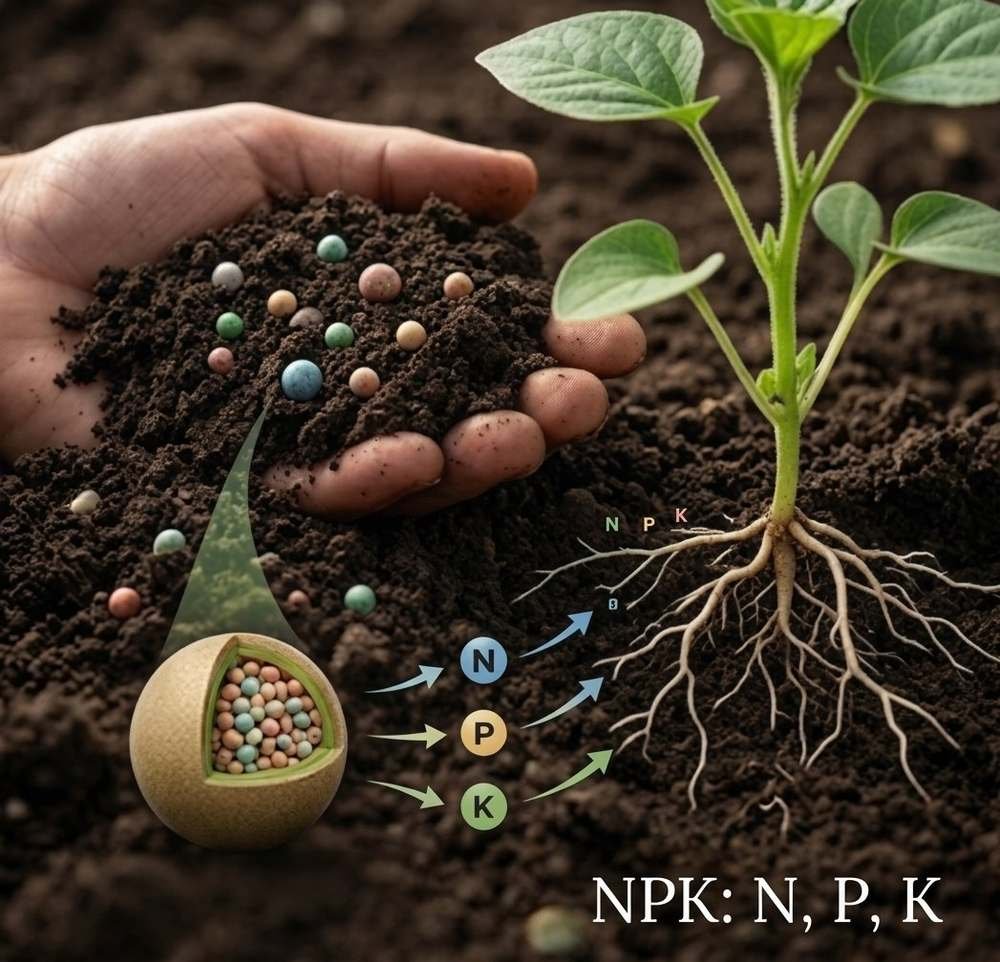
NPK is an abbreviation formed from the initial letters of the three primary nutrients that plants need in the largest quantities for growth and development — Nitrogen (N), Phosphorus (P) and Potassium (K). These three elements are called "macronutrients" because the plant consumes them in far greater amounts than the other (micro) elements.

What does each element do?

Nitrogen (N) — the most important element responsible for the plant's vegetative growth (leaves and stems). It supports chlorophyll production and gives leaves their green color. When deficient, leaves turn pale green or yellow and growth slows. Because it is mobile in the soil, it is easily washed away by irrigation and must be applied regularly.

Phosphorus (P) — plays a key role in root system development, flowering and seed formation. It is essential for the plant's energy metabolism (ATP production). When deficient, the root system remains weak and flowering is delayed.

Potassium (K) — regulates water balance, protein production and overall disease resistance. It improves fruiting and crop quality. When deficient, leaf edges dry out and the plant becomes more susceptible to disease.

What do the numbers on the bag mean?

Every NPK bag shows three numbers separated by hyphens (e.g., 15-15-15, 20-20-0, 8-20-30). The first number is the percentage by weight (%) of Nitrogen (N), the second of Phosphorus (P₂O₅), and the third of Potassium (K₂O) in the bag. For example, a 50 kg bag of "15-15-15" contains 7.5 kg of pure Nitrogen, 7.5 kg of Phosphorus, and 7.5 kg of Potassium — the rest consists of carrier materials and fillers.

How should it be applied?

It is first recommended to have the soil tested — this way you can precisely determine which element is deficient. NPK fertilizers are usually mixed into the soil as a base fertilizer before planting, or applied to the root zone / delivered with irrigation water during the growth period. The amount and timing vary depending on the crop type and soil fertility — it is advisable to consult an agronomist for the exact dosage.

Common mistakes

— Using a single "one-size-fits-all" formula without a soil analysis.
— Applying too much fertilizer at once (this can damage the roots).
— Focusing only on the basic NPK and forgetting secondary elements (such as Sulfur, Boron, Zinc).
— Not irrigating enough after fertilization, so nutrients fail to reach the root zone.

NPK dökün granulasy we ösümligiň kök ulgamy
Practical tips

Articles

Clear explanations of the questions and symptoms most often encountered in the field.

What is NPK 15:15:15 fertilizer used for?

NPK 15:15:15 is the most widely used granular fertilizer, blending Nitrogen (N), Phosphorus (P) and Potassium (K) in equal (15%) proportions. This balance makes it a "universal" fertilizer suitable for a wide range of crops such as wheat, cotton, vegetables and grapes.

It is typically mixed into the soil before planting or during the early growth stage. Nitrogen supports leaf and stem growth, Phosphorus supports the root system, and Potassium supports the plant's overall resilience. It is especially effective as a base fertilizer on soils with low fertility.

Fertilizing in the spring season: what should you do?

Spring is when plants awaken from winter dormancy and enter their active growth period. As the soil warms, root system development accelerates and the plant needs more nutrients.

Applying a balanced Nitrogen-Phosphorus-Potassium blend during this period (e.g., NPK 15:15:15 or NPK(S) 20:20(14)) helps the plant develop a strong leaf and root system. Irrigating after fertilization makes it easier for nutrients to reach the root zone.

Iron deficiency (chlorosis): the cause of leaf yellowing

When the tissue between leaf veins turns yellow while the veins themselves stay green, this is usually a sign of iron deficiency (chlorosis). This condition is especially common in alkaline (high pH) soils, because even when iron is present in the soil, the plant cannot absorb it.

In this case, foliar iron fertilizers applied to the leaves give the fastest results, since they are absorbed directly through the leaf. For a long-term solution, it is recommended to correct the soil's pH.

Calcium deficiency and fruit rot

In fruiting crops such as tomatoes and melons, when the bottom of the fruit turns dark and rots, this is usually not due to a lack of Calcium in the soil, but rather to Calcium not reaching the fruit in sufficient amounts. Calcium moves through the plant together with water, so a balanced watering schedule is very important.

Watering consistently and evenly, and using supplementary fertilizers containing Calcium (e.g., NPK(S) formulas), reduces this problem.

What is Sulphur Coated Urea (SCU)?

SCU (Sulphur Coated Urea) is a technology in which a layer of sulphur is applied around the Nitrogen granule. This coating gives the Nitrogen a slow, controlled "release" into the soil, meaning a single application remains effective for a long time.

Compared to ordinary urea, SCU reduces losses (i.e., the Nitrogen does not evaporate or leach out quickly) and also supplies additional sulphur — an extra benefit that helps protein formation.

Which NPK formula suits which crop?

Cereal crops (wheat, barley): high-phosphorus formulas before planting (e.g., NP 18:46), balanced NPK during the growth period.

Fruit trees (grapes, citrus): high-potassium formulas during flowering and fruiting (e.g., NPK(S) 8:20:30).

Vegetables: since their growth rate is high, a balanced NPK 15:15:15 or supplementary formulas with micronutrients (Boron, Zinc) are more effective.

Cotton: phosphorus-dominant formulas are used at planting to strengthen the root system, followed by balanced formulas during the growth period.

Growth stages

Which element is needed most at each stage of the plant's growth?

01

Seed and germination

Phosphorus is important for the strong formation of the root system.

02

Leaf formation

Nitrogen accelerates leaf and stem growth.

03

Flowering and fruiting

Phosphorus and Potassium support flowering, fruiting and crop quality.

Tohumyň gögermegi
Additional mineral elements

The role of meso- and micronutrients

Besides the primary NPK elements, there are additional mineral elements needed in small amounts for plant health.

Sulfur (S)
Helps protein formation and oil production.
Zinc (Zn)
Supports enzyme activity and growth hormones.
Boron (B)
Necessary for flowering, pollination and cell wall strength.
Calcium (Ca)
Strengthens the cell wall and improves fruit quality.
Export guides

Guides for European buyers

In-depth articles on importing into the EU, choosing a formula, application and quality.

NPK fertilizer manufacturer in Turkey: why European buyers source from Mersin

Europe imports several million tons of compound NPK fertilizer every year, and a growing share of it is produced in Turkey. For distributors and agricultural cooperatives in Spain, Poland, France, Germany and Romania, a producer on the Turkish Mediterranean coast offers something that producers further east cannot: short transit times, a customs union with the EU, and plants that already work to ISO-audited quality systems.

Where Europe's NPK demand is concentrated

According to 2024 trade data, the largest NPK importers in Europe by volume are Spain (about 636,000 t), Poland (about 620,000 t), France (about 464,000 t), Germany (about 280,000 t) and Romania (about 276,000 t). The average European import price in 2024 was around 525 USD per ton. These five markets are exactly the ones a Mersin-based producer can serve most efficiently by sea.

Why Mersin is a logistics advantage

Greenforce's plant is located in Mersin, home to one of the largest container and bulk ports on the eastern Mediterranean. Typical sea transit times from Mersin are roughly 4–6 days to Constanța (Romania), 6–8 days to Marseille, 7–10 days to Valencia or Barcelona, and 15–20 days to Gdańsk via the Atlantic route. Both containerised (bagged, 50 kg or big-bag) and break-bulk shipments are possible. We quote FOB Mersin, so your freight forwarder keeps full control of the sea leg.

Customs union, not a third-country tariff

Turkey and the EU operate a customs union covering industrial goods, and fertilizers fall within its scope. Goods shipped with an A.TR movement certificate enter the EU without the conventional customs duty that applies to many third-country origins. Your customs broker will confirm the current treatment for the specific tariff line (heading 3105 for NPK and NP compound fertilizers).

Quality you can audit

Greenforce operates under a production licence from the Turkish Ministry of Agriculture and Forestry and holds ISO 9001 (quality), ISO 14001 (environment), ISO 45001 (occupational safety), ISO 10002 (customer satisfaction), ISO 31000 (risk management) and ISO 22716 (GMP) certification. Each product is registered with the ministry (Tescil Belgesi) with a declared, analysed nutrient content. Certificates and registration documents are available on our company page.

Order size and how to start

Our minimum export order is 200–500 tons per shipment, depending on formula and packaging. Daily capacity exceeds 150 tons of granular NPK, so a 500-ton order is typically produced within one week. To request a quotation, send us the formula you need (for example NPK 15-15-15, 20-20-0 or 25-0-8), tonnage, packaging type and destination port — see our product list and contact page.

Importing NPK fertilizer into the EU: what buyers need to know

Since 16 July 2022, the EU Fertilising Products Regulation (EU) 2019/1009 has replaced the old Regulation (EC) 2003/2003. It changed how fertilizers are placed on the EU market, but it did not close the door to non-EU producers. This article summarises the two legal routes, the documents an importer should ask for, and the quality limits that matter most for compound NPK.

Two routes to the EU market

Regulation 2019/1009 is an optional harmonisation. A fertilizer can be sold EU-wide as a "CE-marked EU fertilising product" if it meets the regulation's product function category (PFC) and component material category (CMC) requirements and has been through the applicable conformity assessment. Alternatively, a fertilizer can be placed on the market of an individual member state under that country's national fertilizer legislation, and then moved to other member states under the mutual recognition rules of Regulation (EU) 2019/515. Many imported NPK products are sold under the national route, especially when the importer sells in one or two countries.

Key limits for compound NPK

Under 2019/1009, an inorganic macronutrient fertilizer (PFC 1(C)(I)) must declare its nutrient content and respect contaminant limits. The most discussed is cadmium: a maximum of 60 mg Cd per kg of P₂O₅ for phosphate-containing fertilizers, with voluntary "low-cadmium" labelling below 20 mg/kg. Other limits apply to arsenic, lead, mercury, nickel and chromium VI. Declared nutrients must stay within defined tolerances of the labelled values, and the label must show N, P₂O₅, K₂O and secondary nutrients (S, MgO) in the prescribed format.

Documents an importer should request

Whichever route you use, ask the producer for: a certificate of analysis for each lot (N, P, K, secondary nutrients, moisture, granule size, heavy metals); a safety data sheet (SDS) in the language of the destination market; the producer's ministry registration (in Turkey, the Tescil Belgesi) and production licence; ISO certificates; a certificate of origin and, for Turkey, the A.TR movement certificate for customs-union treatment; and packaging and labelling artwork for approval before production.

Customs classification

Compound NPK fertilizers containing nitrogen, phosphorus and potassium are classified under HS heading 3105 (for example 3105.20). NP and NK blends also fall under 3105 sub-headings. Your broker will confirm the exact ten-digit TARIC code and any national requirements such as registration of the importer as the "responsible person" for the product.

How Greenforce supports EU importers

Greenforce products are produced under a Turkish Ministry of Agriculture and Forestry licence, registered with declared nutrient content, and manufactured under ISO 9001 / 14001 / 45001 / 22716-GMP systems. We provide a certificate of analysis for every lot, SDS, registration documents and A.TR paperwork, and we can adapt bag labelling to the destination country's language and format. Ask us for the current conformity file for the formula you need via the contact page.

NPK 15-15-15 vs 20-20-0 vs 25-0-8: choosing the right formula for European crops

The three numbers on an NPK bag show the percentage of nitrogen (N), phosphate (P₂O₅) and potash (K₂O). Choosing between a balanced, a phosphorus-rich or a nitrogen-potassium formula depends on the crop, the growth stage and what your soil analysis already shows. Here is a practical guide for the main European crops.

NPK 15-15-15: the balanced base fertilizer

Equal parts N, P and K make 15-15-15 the standard pre-sowing or planting fertilizer for cereals (wheat, barley, maize), sunflower, rapeseed, vegetables and vineyards on soils of average fertility. It covers the three macronutrients in one pass and is usually applied at 300–500 kg/ha before sowing, followed by a nitrogen top-dressing later. Variants with sulphur (15-15-15 + 7S or + 10S) suit rapeseed, cereals and sulphur-deficient soils common in Poland and northern Germany. See our NPK 15-15-15 range.

NPK 20-20-0: phosphorus for root development

A nitrogen-phosphorus formula without potassium is the choice when the soil already holds enough potassium (typical of many clay soils in Spain, southern France and Romania) and the priority is early root growth. 20-20-0 is widely used for maize, sunflower, winter wheat at sowing and for fruit trees in spring. Greenforce produces 20-20-0 with sulphur (10S), magnesium (2.5MgO) and micronutrients (Zn, B) for crops with higher zinc demand such as maize and citrus. See NP 20-20-0 variants.

NPK 25-0-8: nitrogen and potassium for top-dressing

Once the crop is established, the need shifts from phosphorus to nitrogen and potassium. 25-0-8 + 2MgO + ME is designed for top-dressing cereals at tillering, for maize at 6–8 leaves, for pastures and for vegetables and orchards during fruit development. Magnesium supports chlorophyll formation, and the micronutrient package covers common European deficiencies in zinc, boron and manganese. See NK 25-0-8 + 2MgO + ME.

Higher-analysis and sulphur-coated options

For growers who want fewer passes, 17-17-17 + 2.5S delivers more nutrient per ton. UAS 32.75-0-0 + 12S (urea ammonium sulphate) is a nitrogen-sulphur top-dressing for cereals, rapeseed and grassland. 12-24-12 + 4S + 0.5Zn is a starter fertilizer for potatoes, sugar beet and vegetables, and 11-22-16 + 3.4S suits potassium-demanding crops such as potatoes, fruit and vines.

A simple decision rule

Before sowing with no recent soil test: a balanced 15-15-15. Before sowing on potassium-rich soil or for root crops: 20-20-0 or 12-24-12. During the season: 25-0-8 or UAS. When in doubt, a soil analysis every two to three years pays for itself many times over. Our team can help you match a formula to your crop plan — get in touch.

How to use NPK fertilizer: dosage, timing and application methods

Granular NPK is simple to use, but yield response depends on applying the right amount at the right time and getting the nutrients into the root zone. This guide covers the three questions growers ask most often: how much, when, and how.

How much: typical dose ranges

Doses depend on the crop's nutrient removal, the soil's reserves and the formula's concentration. As orientation values for a balanced 15-15-15 applied as base fertilizer: winter cereals 250–400 kg/ha, maize 300–500 kg/ha, sunflower and rapeseed 200–350 kg/ha, potatoes and sugar beet 400–600 kg/ha, field vegetables 400–700 kg/ha, vineyards and orchards 300–500 kg/ha spread under the canopy. These are starting points — a soil analysis and local agronomic advice should set the final rate.

When: timing by growth stage

Before sowing or planting (base fertilizer): a complete NPK or NP formula is incorporated into the top 10–15 cm of soil, so that phosphorus — which barely moves in soil — sits where the young roots will reach it. During the season (top-dressing): nitrogen-rich or NK formulas such as 25-0-8 or UAS are spread on the surface at tillering for cereals, at 6–8 leaves for maize, and at flowering to fruit set for vegetables and orchards. Split applications of nitrogen reduce leaching losses, especially on sandy soils and in high-rainfall regions.

How: application methods

Broadcast spreading with a disc spreader is the standard method for field crops; granule size uniformity (2–5 mm) and bulk density determine how evenly the product spreads at 24–36 m working widths. Band placement or starter application beside the seed row at sowing uses 20–40 % less product for the same early effect, especially for maize and sugar beet. Fertigation uses water-soluble grades rather than granular NPK. After broadcasting, incorporation by cultivation or irrigation of 15–25 mm helps move nutrients to the roots.

Common mistakes to avoid

Applying one formula to every field without a soil test; applying the full nitrogen dose at once; placing fertilizer in direct contact with seed at high rates (salt damage); spreading on frozen or waterlogged soil; and ignoring secondary nutrients — sulphur, magnesium — and micronutrients that limit yield as often as N, P or K do.

Storage and handling

Keep bags closed, dry and off the floor; granular NPK is hygroscopic and will cake if exposed to humidity. Use the oldest lots first and avoid storing next to urea or ammonium nitrate blends from other sources. For product-specific recommendations, see our product pages or contact our agronomy team.

Granular vs powder fertilizer: why granulation matters for storage and spreading

The same nutrients can be delivered as a fine powder, a prilled product or a granule. For mechanised European farming, granulation is not a cosmetic difference — it changes how evenly the product spreads, how long it stores and how much nutrient reaches the crop. Here is why.

Even spreading at wide working widths

Modern disc spreaders throw fertilizer 24, 36 or even 48 metres. Only particles with enough mass and a consistent size travel the full distance and land evenly; dust and fines drop near the machine and create stripes of over- and under-fertilised crop. A well-made granule of 2–5 mm with a narrow size distribution and good hardness keeps the spread pattern uniform across the whole width, which is why spreader manufacturers publish settings for granular products and not for powders.

Less dust, less loss, safer handling

Powder blows away in wind, sticks to equipment and exposes operators to inhalable dust. Granules keep nutrient losses low during loading, spreading and bagging, and keep working conditions cleaner. For products containing sulphur or micronutrients, granulation also stops the lighter components from separating from the heavier ones during transport.

Every granule carries the full formula

In a physical blend of straight fertilizers, each particle is a different material, and particles of different size and density segregate in the bag, the hopper and on the field. In a compound granule produced by steam granulation, the whole formula — N, P, K, sulphur, magnesium, micronutrients — is in every single granule. Each square metre of the field receives the same ratio, and the roots find all nutrients together.

Storage and caking

Granular NPK has far less surface area than powder, so it absorbs less moisture and resists caking. Greenforce granules are dried to low moisture, screened to size and coated with an anti-caking agent before bagging in 50 kg bags or big bags, which allows storage through a season under dry conditions. The production process page explains each step.

Controlled nutrient release

Granules dissolve more gradually than powder, releasing nutrients over weeks rather than days. This reduces nitrogen losses through leaching and volatilisation and keeps nutrient supply closer to the crop's uptake curve. Sulphur-coated nitrogen (SCU) takes this one step further for extended-release programmes.

What to check when buying

Ask for granule size distribution (share between 2 and 5 mm), crushing strength, moisture content and bulk density on the certificate of analysis — these four numbers tell you more about field performance than the nutrient figures alone. Greenforce supplies these values for each lot; see our product list or contact us for samples.